

The Fourth Crusade: Act IV
Thou Shalt Not Kill... Unless it is Profitable

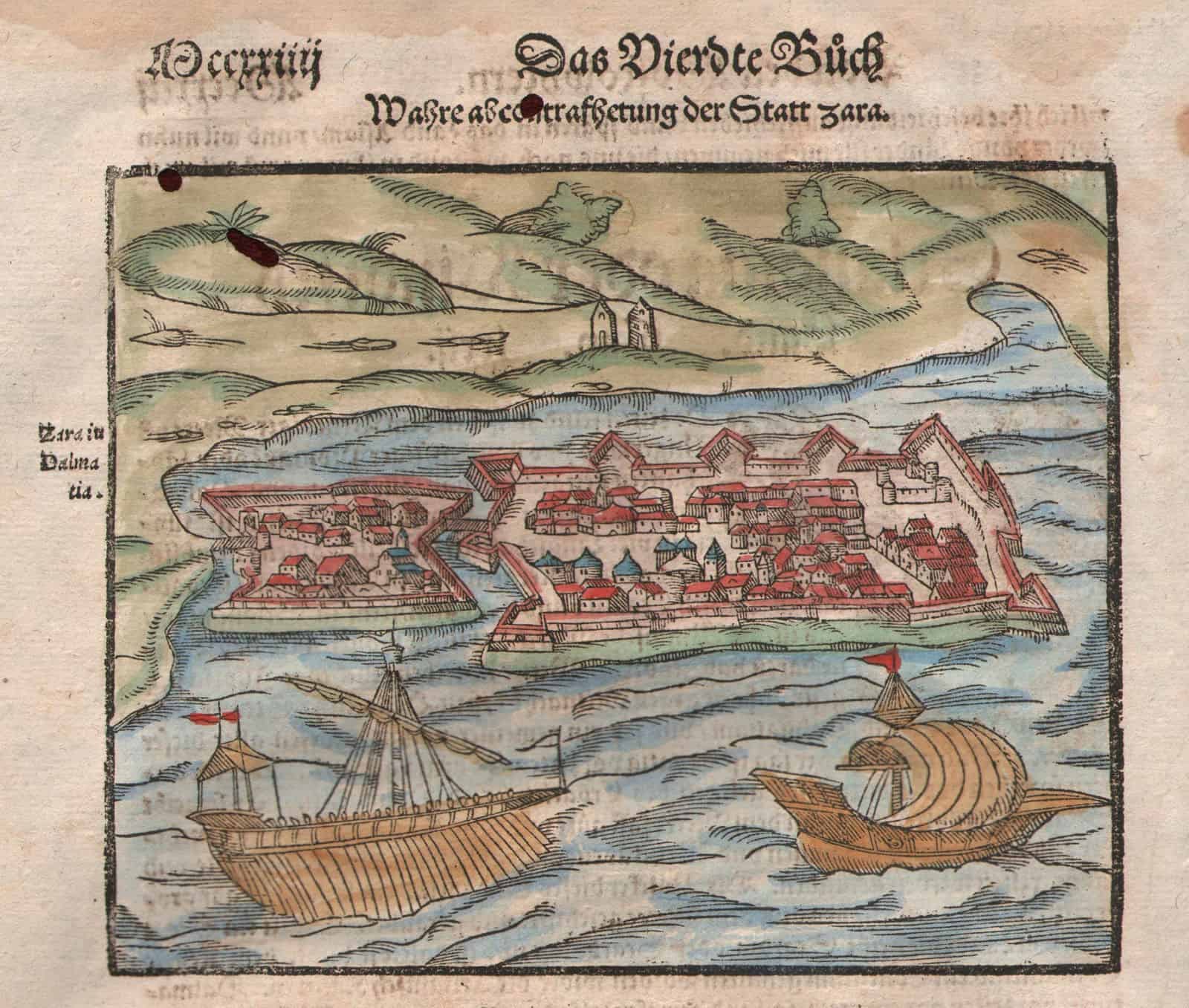
Good day traveler, welcome to Zara.
I would show you around, but the city is not at its best, you see they are preparing for a battle they know they cannot win.
Still, let’s find a nice quiet place to sit, have a drink, and enjoy the city before it is destroyed. Despite the Pope’s letters, these streets are to run crimson with blood and echo with screams of terror and rage.
There it is. Do you hear it? The drums of war are pounding; the air is thick with anticipation. The battle is about to begin.
The Crusaders have come, not for glory nor in the name of their God.
They have come to pay their debt to an ambitious man.
But first, let's turn back the pages of time, to the attempted negotiation of peace, and the misunderstanding that would have saved lives.
Before we begin, if you have somehow found your way here and seem to be lost, you can catch up by reading the previous act.

Simon Says: Peace.
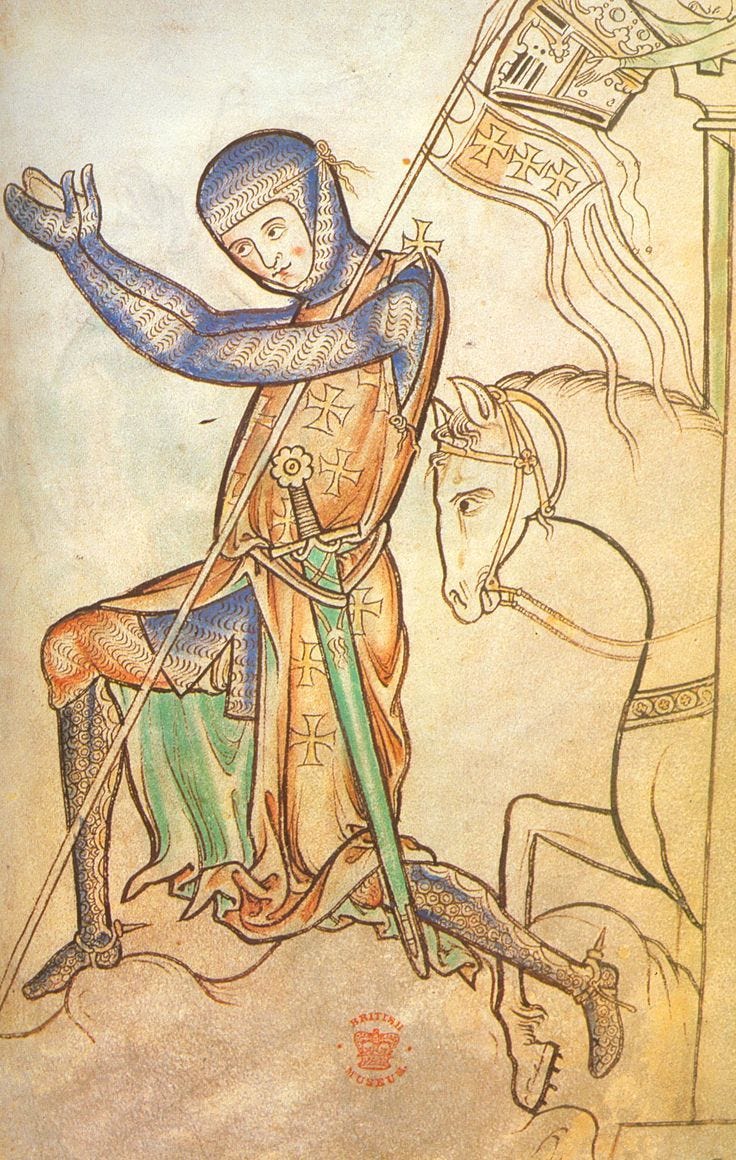
Simon de Montfort was not yet thirty when he joined the crusade under Thibaud de Champagne in 1199. Deeply religious, he joined while taking part in a tournament in France.
Because of this, upon receiving the letter from the Pope, he refused to take part in something so deeply against the core of his beliefs.
For a moment, I want you to understand the gravity of the situation. Prior to the siege, the Crusade was still an idea, an ideal. But reality would soon set in for many of the crusaders as they realized that with their swords, with their actions, they would be killing innocents who had done nothing more than separate from their Venetian rivals.
To kill a man with a blade is a deeply personal and scarring moment; it requires absolute conviction.
For Simon, killing his fellow brothers in Christ was irrevocably unforgivable. If Zara were to fall, he would have no part in it.
And thus, he refused.
If he had just left, if he had spoken no words, death would have been avoided.
Alas, he spoke out, he made a promise that he could never keep, for it was not his promise to make.

When the crusaders arrived, Zara had already received word that an attack was impending. Men prepared to fight, but they knew with the size of the army, there would be no change of success. Outrage and betrayal clouded the city as they sent envoys to meet with Dandolo.
They offered to lay down their swords, open their gates, and accept defeat if only they would be spared. Dandolo, ever the politician, told the envoys that he would first have to speak to the leaders of the crusade.
You may be wondering, Why would he not agree? That is exactly what he wanted?
Well yes and no. This ‘expedition’ needed to appear to be a team effort. This a Crusade, NOT a Venetian endeavor. By shifting some of the responsibility to the others, it ensured that Venice was not acting alone.
Despite that, the Pope had already sent out a letter threatening excommunication to those that dared attack. Excommunication was more than being ‘kicked out,’ it was isolation, it was damnation, it was well… embarrassing.
Proceeding meant profit and would restore Venetian pride and control of trade in the Adriatic Sea. But it would also mean they would seal their fates in the eyes of God.
As the Doge stepped out of the negotiations to consult his associates, Simon stopped for a quick chat with the envoys.
The conversation went something like this1,
“Why are you opening your gates? Why not fight? Surely you know that the French will not attack, they would not dare! You should fight!” I imagine Simon explaining this with all the righteousness and subsequent foolishness a man has to offer with a tone of dignity and misplaced confidence.
“I see. Will you give me your word?”
“Of course! I am a man of honor, as are my brethren, they will not attack!”
And of course, he was completely wrong. It wasn’t that the others wanted to kill the innocents in the city, but they were mountains of silver in debt with no way to pay it back.
When the Doge returned with the happy news that they would indeed accept the Zaran’s offer, the envoys were gone, readying the defenses in their city and preparing to fight.
You will find, coincidentally, Boniface had to ‘take care of some matters at home’ and headed to Phillip of Swabia’s court. This is when he will meet our young Prince Alexius.
The decision was made, despite Simon’s words and the hesitation of the Crusaders, they would proceed with the attack on the city.
Simon, outraged by his countrymen, took his own men and decided he would make his way to the holy land on his own.
A Slight Deviation into 13th Century Medieval Siege Warfare
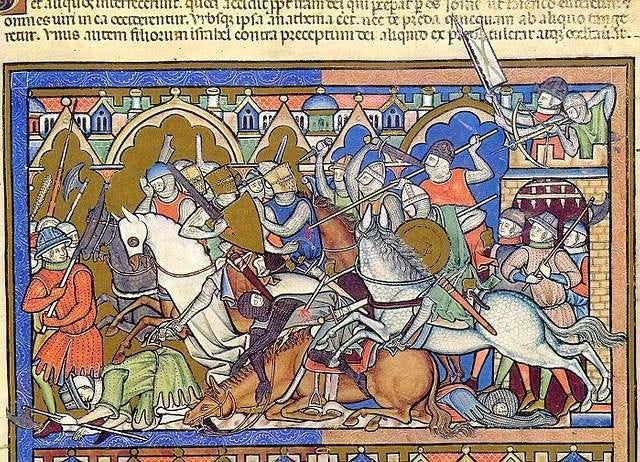
I would like you to take a second and imagine you are a soldier preparing for your first battle and your first siege. I won’t tell you where you are from, since you are your own person with your own brain and may identify with the Venetians or the French.
This is unimportant to me and to the point. You are in Zara, and you cannot take your eyes off of the intimidating walls of the city.
Your hand clasps the handle of your sword and despite the nice and cool November breeze, sweat beads on your brow. Your heart feels like it must be beating out of your chest and your mouth goes dry.
Today is the day.
Before we charge into battle, it is important for you to understand what weapons you must take with you into battle to be a successful crusader and to give you your best shot at surviving through the day.
There are the obvious heavy hitters: Ladders, swords, men in armor, bows, arrows, enough courage to rush into battle against flaming arrows and stone.
But what we are going to look first at the bigger picture, what ‘war machines’ are you bringing to Zara?
Great Question. So glad you asked.
In Chronicles of the Crusades, Geoffroi de Villhardouin notes2;
“When the ships had been loaded with arms and food, and the knights and sergeants had embarked, their shields were hung round the sides and on the ships’ castles alongside their banners, of which there were many splendid ones. Know that they were carrying more than 300 petraries and mangonels in those ships, and many of every kind of machine useful for capturing a city.”
Let’s break that down.
Your first weapon would be the fleet itself, you see Zara is a seaside city, their walls bordering the water. And Venetian ships were built ‘Ford Tough,’ some even with iron reinforced hulls strong enough to ram harbor defenses.
Petraries is similar to a catapult which is designed to throw stones and includes a couple different “throwing” siege weapons:
You first have a mangonel. This is a catapult type weapon with low to moderate level accuracy. You can see below that at the bottom there are ropes connected with men pulling at them, activating the catapult action. This would have been used to damage walls3.
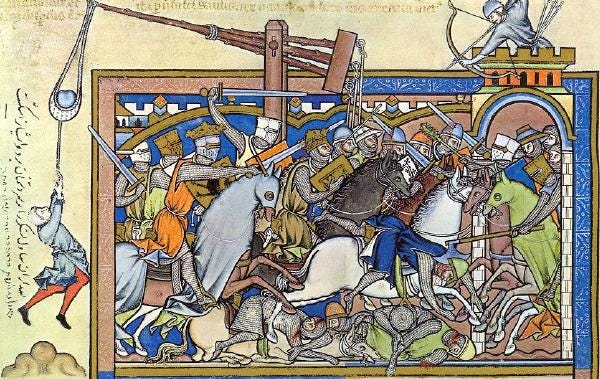
Mangonel: Illustration from a French book made for king Louis IX (or Saint Louis) in 1250. Book is kept in Pierpont Morgan Library (New-York), Public Domain

It can also apply to a counterweight trebuchet, which is not directly mentioned but could have been used, as this weapon was gaining traction in the west at the time. It can be traced back to the early twelfth or late eleventh century4. Essentially weight is dropped on one end of the long arm, causing the other (holding the sling and projectile) to whip upward and launch the projectile through the air.

And of course you will need ladders. They were used to prop against walls. Though you will find when it works it is effective and often needed; but it also costs lives. A lesson?
Never be the first one up that ladder.
And lastly, you need the men, a lot of men if you are to attempt the siege. Specifically? You need foot soldiers that are the first to climb the ladder.
The Attack

And thus, we have returned to the impending doom of a city.
Inside the walls the tension is palpable, and citizens wear fear like a shawl.
Outside, you are preparing to sacrifice your soul for the greed of other men.
The call of war sounds, and the ships approach the walls, ladders being pushed up and readied as arrows rain down upon your fellow soldiers. Next to you, you watch as one finds its home in the chest of a man you have known since you were a child. He sputters and collapses to his knees as another embeds itself into his throat.
Behind you, your commander screams at you to climb.
You pray to whatever god that will listen as you approach, holding a shield above your head as your hands touch the wood.
But before you start your climb, you duck out of the way as a man from above falls, wailing all the way down. The water below splashes with others just like him, a single moment ending their entire lives.
All around you, men fall, blood gushes, and screams fill your ears.
You are certain today is the day you die.
And yet, you start to climb.

On the tenth day of November, the crusaders arrived in Zara aboard the ships that had cost them so dearly. On the thirteenth the defenders hung crosses from their city walls, their hope in vain that the crusaders would remember that they were brothers in their faith.
Fellow traveler, this is where any hope of redemption of the Crusade dies.
Once the crusaders broke the chain blockade to the city, the assault began.
It lasted five days before a new tactic was introduced. The mine.
Mining in this era meant that tunnels would have been dug under the towers to bring down the city walls as the crusaders were attacking from the top. This was worse than flaming arrows, ladders, and trebuchets. Those you could see.
This would be a death carved by unseen hands, dragging foundations from underneath the city.
Once the Zarans realized this, they pleaded for the truce they originally had offered.
It was accepted on November 24th, 1202. The crusaders entered the city, victorious, and unaware of what the winter would hold within the city that they had conquered.
A Bloody Winter

Winter was coming, and the Crusaders were in need of supplies and a place to rest. So, it was decided that they would stay in the city until Easter.
But you see friend, tensions had been simmering before surrender, and they were soon to boil over.
The Doge held a meeting with the French crusaders, and it was decided that the Venetians would reside in half of the city, where the ships were anchored and the French would occupy the other half. A good idea in principle but would not stop the violence that was impending.
Resentment flowed through the streets like a river, and the city was far too tight to hold in the water for long.
You see, the excommunication from Pope Innocent III drifted through the air, finding a home in the minds of many of the men. It was supposed to be a holy war, and they had just committed foul acts, all under the eyes of their lord watching over them.
It would not be unreasonable, to presume that the French blamed the Venetians for their position and for their own sins.
If you think about it, it was bound to happen eventually.
In the evening, Geoffroi says on the third day, so we must assume it is the 27th of November, a brawl broke out between the two factions. Perhaps it started as many do, with a word of warning and a single act of aggression. But in the end, more blood was spilled, and many more lives were lost…
By the time peace was agreed upon, both sides were depleted and their spirits a little darker.
So, there they were, in a city they weren’t supposed to sack, amongst a people they weren’t supposed to kill, still excommunicated, still angry, and still divided.
But the worst part? They still were no closer to taking the Holy Land.
And they never would.
Next Up? Alexius takes a trip to the newly renovated city of Zara.
Thank you for reading Act IV. I have done my very best to make sure the information given is historically accurate, however if you have any notes/corrections, feel free to share.
My goal is to make historical events, people, and places assessable and interesting for those who love history and those who think of it as a chore worse than doing the dishes.
If you would like to support this page, you can subscribe, share the story, and donate if you wish.
Please note, these are not direct quotes. Though if you believed they were, you haven’t been paying attention.
Geoffroi was a French knight who fought in the crusade, so he is one of the few primary sources we have. Keep in mind that his numbers are not always going to be exactly accurate, which was common for the time. He wrote ‘On the Conquest of Constantinople,’ which details much of the crusade.
Why did they have to make siege warfare look so fun and colorful?
We are NOT going to go very deep into this for a couple reasons. One, it isn’t directly mentioned, and two it has very little impact on our story. BUT it is a very important weapon that became integral to sieges in later years.
Excuse me, I am ready for the next part 😤